
By Rising Revenue Solutions · Published October 22, 2026 · Marketplace policy information reviewed October 22, 2026
Table of Contents
- What has changed in Headway’s marketplace fee policy?
- How the recurring fee may affect provider finances
- What providers should verify before making a decision
- Headway versus independent private practice: key differences
- Why therapists are considering greater practice independence
- The realities and costs of running your own practice
- How an RCM partner can help simplify the transition
- A practical checklist: are you ready for private practice?
- Frequently asked questions
- Conclusion: own the decision, not just the reaction
Introduction
If you built your caseload with help from a platform, a $9.99 charge can look small – until you notice the words that come with it: per appointment, for as long as you see that client.
That is why Headway’s new marketplace service fee has become one of the most discussed topics among US therapists, counselors, psychologists, and social workers this fall. The concern is understandable. Long-term, loyal clients are the foundation of a healthy mental health practice, and a fee that repeats on every session changes the economics of those relationships.
This guide explains what Headway has actually announced – based on Headway’s own documentation, including an important timing change since the fee was first reported – shows the simple math with every assumption labeled, and helps you weigh staying, going hybrid, or building an independent private practice, including how a revenue cycle management (RCM) partner can carry part of that work.
One message runs through it: your clinical expertise is your greatest asset. With the right operational and revenue cycle support, you can explore building a practice that gives you greater control over your business, finances, and long-term goals. That does not mean every provider should leave Headway. It means every provider should run their own numbers first.
1. What has changed in Headway’s marketplace fee policy?
According to Headway’s official Help Center article, “Understanding the marketplace service fee,” Headway is introducing a $9.99 marketplace service fee on every appointment with a new client who finds you through its marketplace – the part of Headway where prospective clients search for care. Headway says the fee supports marketplace improvements, marketing, health system partnerships, and support.
Here is what the official documentation states, as reviewed on October 22, 2026:
- Amount and structure. $9.99 per appointment, the same amount for every health plan. It applies to both insurance and private-pay sessions, and it is deducted from your regular payout – there is no separate bill.
- It repeats. The fee applies for as long as you see that client, not just at the first session. A client’s source is set by how they first found you, and it stays the same for all later sessions with that client. Source is set separately for each provider.
- Which clients qualify. The fee applies when a client first found you through Headway marketplace matching, a Headway ad, Headway’s booking team, a connected partner (including health plans and health systems), or Headway’s AI integrations such as ChatGPT – and booked on or after your state’s start date.
- Who is exempt. No fee applies to: sessions before your state’s start date; clients you add yourself (using Add Client or your calendar); clients who book through your direct link (for example, from your Psychology Today profile, your website, or your email signature); clients who come straight to your profile on their first visit from a search engine (not an ad) or by searching your name on Headway; clients you started seeing before the fee started in your primary practice state; and sessions that do not take place (cancellations and no-shows are not charged, and any cancellation fee you charge is still paid to you in full).
- Rollout timeline – updated. The fee is being introduced state by state starting November 2026, reaching every state by the end of 2026. Headway says you will be notified at least 7 days before it starts for you, by email and an in-product banner, and it is never applied retroactively. The fee follows each provider’s primary practice state, so a multi-state group practice may see it apply to some providers before others. Note: when the fee was first reported in early October 2026, coverage pointed to an October start in a first group of states. Headway’s current Help Center position is the November state-by-state rollout above. If you saved an earlier announcement, replace it with the current terms.
- It is not a rate change. Headway states the fee “isn’t a change to your contracted rate, and there’s no impact on what clients pay for care.” Your contracted rate and the amount you ultimately retain after fees and business expenses are two different things – Section 2 shows why that distinction matters.
- Marketplace appearance is a choice. You can turn your marketplace appearance on or off in Sigmund (Settings → New Clients Settings). Turning it off stops new marketplace clients from finding you; it does not remove the fee from clients who already qualified. Your direct link keeps working either way.
Other Fall 2026 updates. Headway’s Fall 2026 release also announced an upgraded EHR (Zoom-powered telehealth, a session-prep sidebar), private-pay fees reduced to 2.95% per session, annual chart reviews (a sample of up to ten notes, shared within 30 days when selected), and outcome assessments – from October 12, talk therapists are asked to have adult clients complete a baseline assessment such as the PHQ-9 or GAD-7 where clinically appropriate, plus one follow-up per client per year. Those expectations apply while you practice on the platform, whatever you decide about the fee.
A note on the provider agreement. Separately, mid-October third-party reporting described a new provider agreement rollout that Headway then paused after provider pushback. That is not confirmed on Headway’s official fee page, and terms may have changed. Treat it as a prompt, not a conclusion: read the current agreement in your own Sigmund account (Settings → Billing → See rates → Agreement tab) before relying on any summary – including this one.
Reporting vs. official position: Behavioral Health Business reported on October 2, 2026 that the announcement drew clinician pushback; a Headway spokesperson confirmed to that publication that direct-link and existing clients carry no fee. The fee’s amount, scope, exemptions, and timeline here come from Headway’s official documentation, which takes priority where accounts differ.
2. How the recurring fee may affect provider finances
The math is simple, and that is exactly why it deserves attention. The formula is:
Qualifying appointments × $9.99 = marketplace fees deducted from your payouts
Hypothetical examples – these are fees on affected appointments only, not charges on every session you provide:
| Affected appointments | Fee total |
|---|---|
| 10 appointments | $99.90 |
| 20 appointments | $199.80 |
| 50 appointments | $499.50 |
| 1 client, weekly, 52 weeks (52 appointments) | $519.48 per year |
| 5 marketplace clients, weekly, 52 weeks (260 appointments) | $2,597.40 per year |
| 10 marketplace clients, weekly, 52 weeks (520 appointments) | $5,194.80 per year |
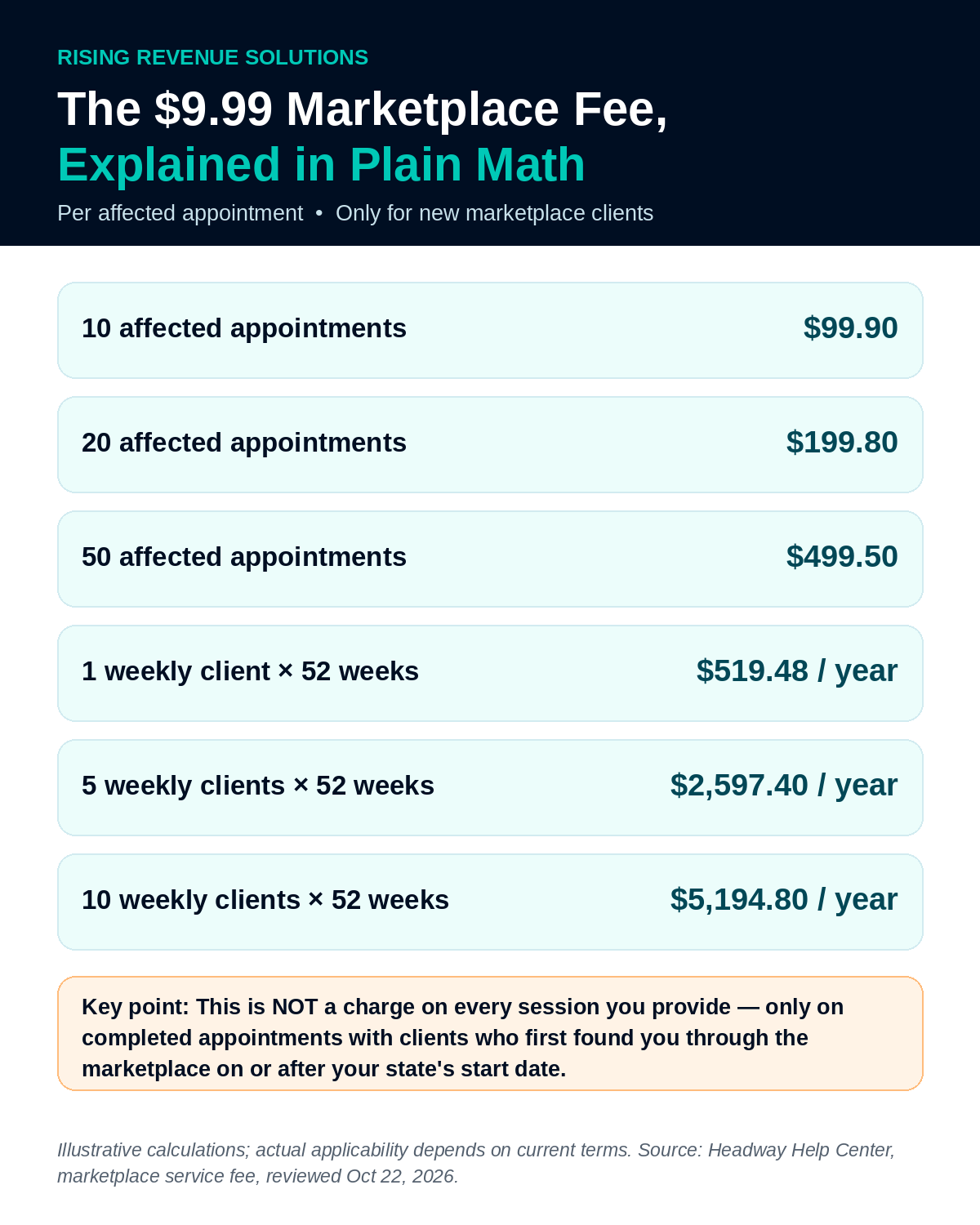
Assumptions, labeled: every appointment above is a completed appointment with a qualifying marketplace client; no cancellations; 52 weeks of continuous weekly care. Real caseloads include breaks, bi-weekly schedules, and mixed sources, so run the formula with your qualifying appointment count – which you can check per client under Pricing on each client’s page, and in your Payments tab.
Two planning points follow. First, a contracted rate is not take-home revenue. If a hypothetical session would otherwise produce a $120 payout, a qualifying session retains $110.01 after this fee, before other expenses. The rate did not change; what you keep did. Second, recurring fees compound with relationship length, and good therapy relationships are often long. A fee charged in month eighteen behaves differently from one charged in week one – that indefinite repetition is the core of the reported provider objection.
Balance matters, though. A marketplace client who fills an otherwise empty hour may still be worthwhile after the fee. The right comparison is never “fee versus no fee” – it is net revenue and workload from this channel versus your realistic alternatives.
3. What providers should verify before making a decision
Before you change anything, verify these in your own account and agreement:
- Your state’s start date and your notification – check your email and Sigmund banner; Headway promises at least 7 days’ notice.
- Each client’s source under Pricing on the client page. Source determines the fee, and it is set by the first way the client found you.
- Your direct link. Find it in your Profile settings and use it everywhere you generate your own referrals – Psychology Today, your website, your email signature. It is the clearest fee-exempt path Headway documents.
- Your rates and agreement. View rates by carrier and CPT code in Sigmund, and read the current agreement in full – including any termination, notice, and post-termination clauses – before making commitments based on it. This article is education, not legal, tax, or contract advice; consult qualified professionals for your situation.
- Your marketplace setting. Decide deliberately whether your marketplace appearance stays on, rather than letting it default.
- Your real numbers. Count last quarter’s completed appointments by source. That count – not your total caseload – is your fee exposure.
4. Headway versus independent private practice: key differences
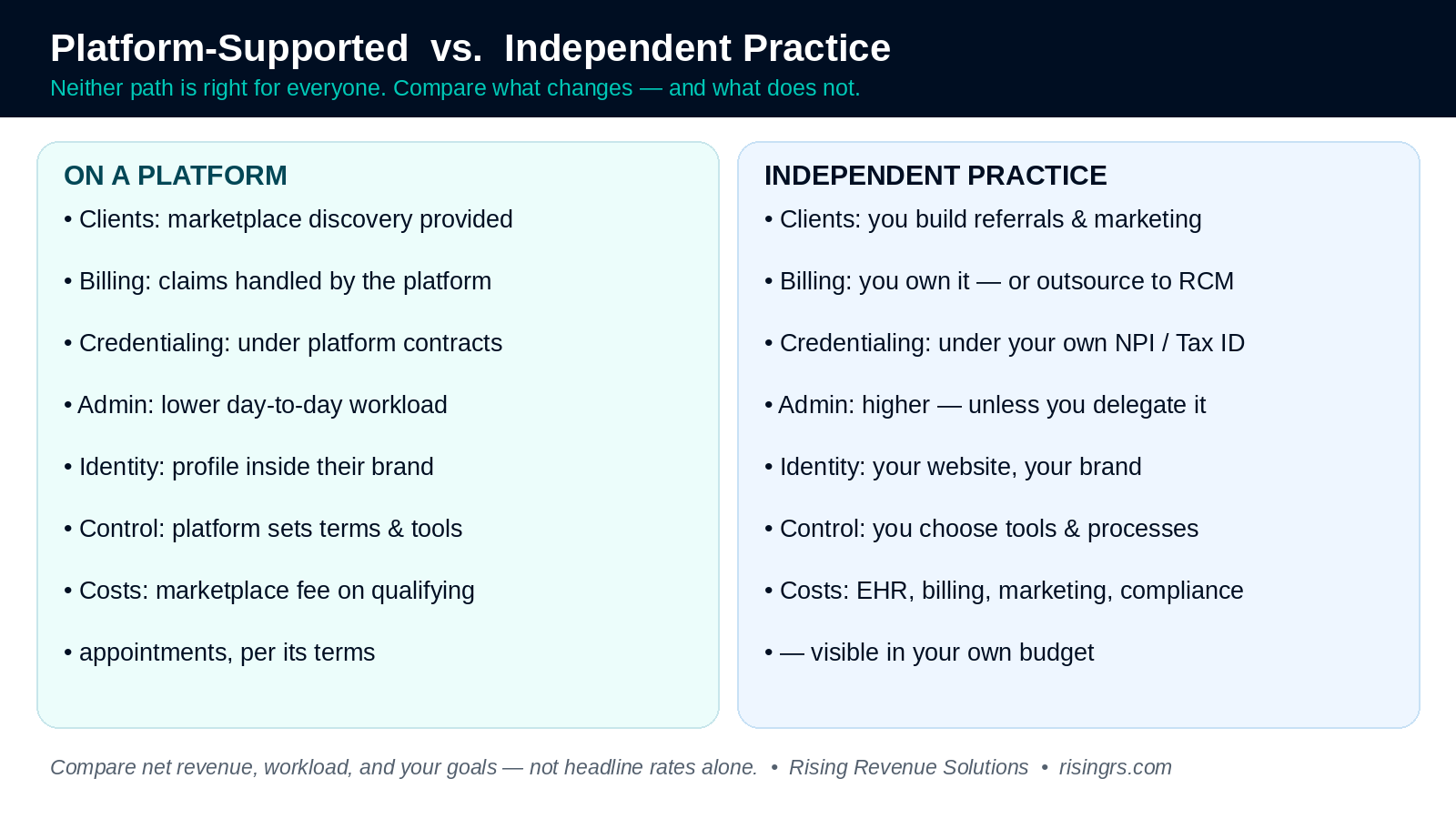
| Area | Platform-supported practice (e.g., Headway) | Independent private practice |
|---|---|---|
| Client acquisition & referrals | Marketplace discovery and marketing provided; fee applies to qualifying marketplace clients | You build and own your referral sources: website, directories, professional relationships |
| Billing & claims management | Platform submits claims and pays providers on a regular cycle (Headway states it pays every two weeks, whether or not the insurer has paid) | You – or your RCM partner – submit, track, post, and follow up on every claim |
| Insurance credentialing & payer enrollment | You practice under the platform’s payer contracts and rates | Credentialing and enrollment under your own NPI / Tax ID; contracts are yours and portable |
| Revenue visibility & reporting | Payout and fee detail in the platform’s Payments views | Full visibility: you see contracted rates, collections, AR, and every expense line |
| Administrative workload | Lower day-to-day billing administration | Higher – unless deliberately delegated to staff or an RCM partner |
| Business identity & marketing | A profile inside the platform’s brand | Your own practice name, website, and brand that you build over time |
| Operational control | Platform sets tools, workflows, and terms – and can change them | You choose your EHR, processes, and vendors, subject to payer and state requirements |
| Fees & operating expenses | Marketplace fee on qualifying appointments; platform retains a share of session payments that varies by plan (per Headway’s rates page) | EHR, billing/RCM, credentialing, marketing, and compliance costs – visible in your own budget |
| Compliance & payer requirements | Platform structures much of this, with provider obligations for documentation, chart reviews, and assessments | You are directly responsible, with support you arrange |
| Scalability & long-term planning | Growth inside one company’s rules and roadmap | You set the growth plan: associates, groups, new locations, new services |
No column wins on every row. Remaining on Headway, turning off marketplace appearance while keeping direct-link clients, running a hybrid (platform plus your own referrals), or transitioning to an independent practice can each be the right answer – depending on your net revenue, your tolerance for administration, and your goals.
5. Why therapists are considering greater practice independence
For many providers, this fee discussion is really a control discussion. Independence can offer:
- Control over branding and identity – a practice name and reputation that belong to you.
- A real business asset – a professional website and a referral network that grow in value over time.
- Ownership of marketing and acquisition – diversified referral sources instead of heavy reliance on one platform’s marketplace.
- Financial visibility – direct sight of contracted rates, collections, expenses, and profitability by payer.
- Choice of tools and processes – the EHR, scheduling, and billing workflows that fit how you practice.
- Long-term planning on your terms – hiring, expanding, or specializing when you decide the practice is ready.
None of that is automatic, and none of it is a promise of higher income, more clients, or zero fees. Independence trades a platform’s fees and rules for your own costs and responsibilities. The next section is the honest other half of the decision.
6. The realities and costs of running your own practice
An independent mental health private practice makes you a business owner as well as a clinician. Depending on your model, payers, and state, responsibilities typically include:
- Credentialing and payer enrollment, CAQH maintenance, and re-credentialing
- Eligibility and benefits verification before sessions
- Claims submission, rejection handling, and payment posting and reconciliation
- Denial management, appeals, and accounts receivable follow-up
- Contracting, documentation standards, and HIPAA and payer compliance
- Bookkeeping, tax coordination, and business administration
- Marketing, website maintenance, and referral development
- Technology costs: EHR/practice management, clearinghouse, telehealth, phone, and secure email
Credentialing also takes time – payer enrollment is rarely instant, so a transition planned before you need it protects continuity of care and cash flow. The actual workload depends on what you keep in-house and what you outsource. Which leads to the practical question: what can a partner carry?
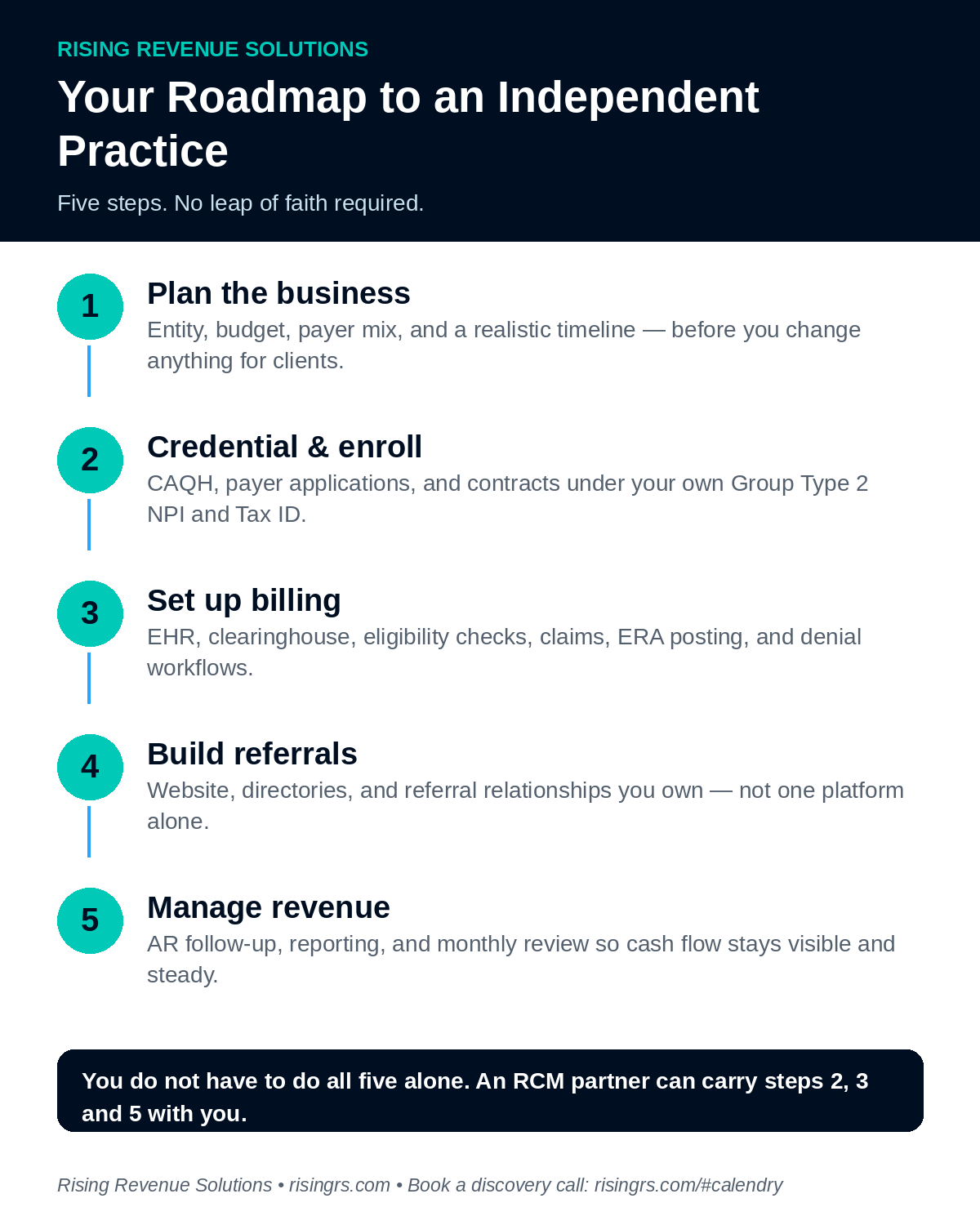
7. How an RCM partner can help simplify the transition
Think of your practice in three layers. Clinical responsibilities always stay with you. Practice ownership responsibilities – choosing payers, setting policies, directing growth – stay with you too. Administrative execution – the repetitive, deadline-driven billing work – is the layer that can be delegated.
That is where Rising Revenue Solutions (RRS) works. Based on the services published at risingrs.com/services, RRS supports practices with:

- Credentialing & Enrollment – provider enrollment, CAQH maintenance, and payer contracting support. In RRS’s Independence Model, credentialing is done under your own Group Type 2 NPI and Tax ID, so your payer contracts belong to your practice.
- Eligibility & Benefits Verification – coverage checked before services are rendered.
- Medical Coding support, Claims Submission, and Rejections Management – clean, timely claims and proactive handling when they bounce.
- Payment Posting & Reconciliation, Denials Management, and AR Follow-Up – the follow-through that turns submitted claims into collected, visible revenue.
- Patient Support & Billing, Front Office Management Support, Practice Audit, and Analytics & Reporting – so you can see performance and make decisions from real numbers.
- Practice growth support – healthcare digital marketing, business website development, and practice management solutions for providers building their own brand and referral base.
The goal is simple: less time navigating billing administration, more time on patient care and practice development. An RCM partner does not guarantee reimbursements, a specific revenue increase, or zero denials – no honest partner can. What it can do is run a disciplined revenue cycle, report it transparently, and make the operational side of independence manageable for a solo provider or a growing group.
8. A practical checklist: are you ready for private practice?
Financial readiness
– ☐ I know my current net revenue by referral source, after all platform fees
– ☐ I have a 12-month independent-practice budget (EHR, billing, marketing, insurance, licenses)
– ☐ I have a cash reserve or a phased plan that protects cash flow during credentialing
Payer enrollment
– ☐ My CAQH profile is current and under my control
– ☐ I have a target payer list and have started (or scheduled) applications under my own NPI / Tax ID
– ☐ I understand my current platform agreement’s notice and post-termination terms
Billing workflows
– ☐ Eligibility verification, charge entry, submission, posting, and denial workflows are defined
– ☐ I know who owns AR follow-up – me, staff, or an RCM partner – and how it is reported
Compliance responsibilities
– ☐ HIPAA policies, documentation standards, and malpractice coverage are in place
– ☐ I have qualified legal/tax advice for my entity and state
Referral development
– ☐ My website and directory profiles (with my direct contact paths) are live or planned
– ☐ I have at least two referral sources that do not depend on a single platform
Technology & administrative support
– ☐ EHR, telehealth, clearinghouse, and secure communication tools are selected
– ☐ Administrative support is arranged for the hours I cannot cover clinically
If several boxes are unchecked, that is not a “no.” It is a work plan – and exactly the kind of plan a discovery call is for.
9. Frequently asked questions
Does the Headway marketplace fee apply to all my clients?
No. Per Headway’s Help Center, it applies only to completed appointments with new clients who first found you through the marketplace (including Headway ads, its booking team, connected partners, or AI integrations) on or after your state’s start date. Clients you bring yourself, direct-link bookings, and clients you saw before your start date are exempt, as are cancelled or no-show sessions.
Is the $9.99 a one-time referral fee?
No. Headway states it applies to every appointment with a qualifying client, for as long as you see that client, for both insurance and private-pay sessions. That is why one weekly client over 52 weeks totals $519.48 in hypothetical fees.
When does the fee start in my state?
Headway states rollout begins state by state in November 2026 and reaches every state by the end of 2026, following your primary practice state, with at least 7 days’ notice by email and in-product banner. Headway has not published a public state-by-state date list in the fee article – verify your date in Sigmund.
Did Headway change my contracted rate?
Headway states the fee is not a change to your contracted rate and does not change what clients pay. It is deducted from your payout, so the amount you retain per qualifying session falls even though the rate itself is unchanged.
If I turn off my marketplace appearance, do the fees stop?
Only for new clients. Turning off marketplace appearance stops new marketplace clients from finding you, but clients who already qualified remain marketplace clients and their sessions still include the fee. Your direct link continues to work.
Should I leave Headway and start an independent practice?
That depends on your numbers, not on a headline. Compare your current net revenue, workload, and support against a realistic independent budget – including credentialing timelines and the cost of billing support. Staying, going hybrid, or transitioning in phases are all legitimate options. Do not terminate any agreement before you have reviewed its current terms and have a continuity plan for clients and cash flow.
10. Conclusion: own the decision, not just the reaction
Headway’s marketplace can be a useful source of clients, and for some providers the new fee will be an acceptable cost of that channel. For others, a recurring per-appointment fee on their longest relationships is the moment to ask a bigger question: what would it look like to build a practice I own – my contracts, my brand, my referral network, my numbers?
You do not have to answer that question alone, and you do not have to answer it in a hurry. Run the math on your own caseload. Verify your terms. Then, if independence is on your list, plan it properly – credentialing first, billing workflows ready, referrals diversified – so a transition protects your clients and your cash flow.
Your clinical expertise is your greatest asset. With the right operational and revenue cycle support, you can explore building a practice that gives you greater control over your business, finances, and long-term goals.

Ready to talk it through? Book a free discovery call with Rising Revenue Solutions: https://risingrs.com/#calendry – we will review your current setup, your numbers, and the practical next steps for your practice, with no obligation.
Educational content only. This article is not legal, tax, or individualized insurance-contract advice. Headway policy summaries are based on Headway’s public documentation reviewed October 22, 2026 and may change; verify current terms in your own provider agreement.